







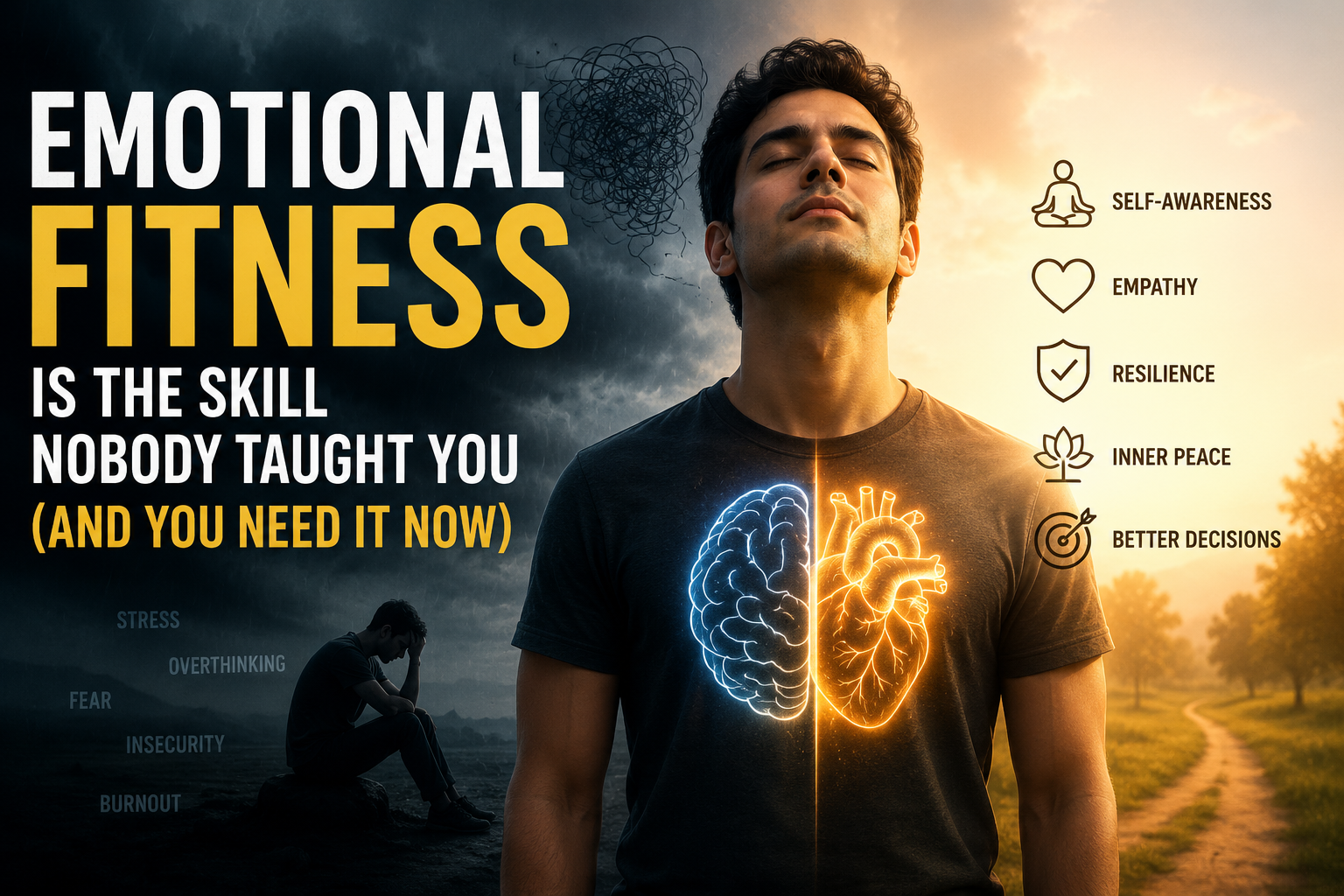
Emotional Fitness Is the Skill Nobody Taught You (And You Need It Now)
Nobody ever sat you down and taught you what to do when you’re furious, humiliated, or gutted by disappointment. Someone told you to calm down. Someone told you to think positive. Maybe someone sent you to your room until you “figured it out.” Nobody gave you an actual skill. Something you could practice. Something you could get better at. Something you could rely on the next time a feeling too big to wish away lit up your whole body.
That skill has a name now. Once you see it, you can’t unsee how badly you missed learning it: emotional fitness. And the reason it’s suddenly everywhere isn’t hype. People are finally admitting the old advice never worked.
A friend of mine texted me last month after a brutal day at work: “I know I’m supposed to just stay positive about this, but honestly? I don’t want to. I just want to be annoyed for like an hour.” She’d just learned that a project she’d spent three months on had gotten quietly shelved in a meeting nobody invited her to. Her first instinct, right after getting blindsided like that, was to apologize for not immediately reframing it into something more palatable.
That’s the whole problem in one text message. We’ve all learned to skip straight to the “silver lining.” Nobody hands us an actual tool for the feeling itself.
What Emotional Fitness Actually Is (It’s Not Positivity)
Emotional fitness means building your capacity to handle whatever you feel — good, bad, or genuinely awful. Not by suppressing it. Not by letting it rule you either. Forget “thinking happy thoughts.” Picture literal physical fitness instead, except you’re training your nervous system, not your quads.
You don’t get physically fit by pretending you’re not tired mid-workout. You get fit by training your body to handle more than it could before. Emotional fitness works the same way. You’re not training yourself to stop feeling anger, grief, or anxiety. You’re training your capacity to feel those things fully and still function, still think clearly, still make decisions you won’t regret tomorrow.
Why Nobody Taught You This Growing Up

Almost nobody grew up learning this skill. Most of us learned two options instead: bottle feelings up (“don’t cry, it’s fine”), or paper over them with forced cheer (“look on the bright side!”). Emotional fitness throws both of those out. The goal was never suppression. It was never denial either. The goal is regulation, and regulation is a skill, not a personality trait you either have or don’t.
Why the “Just Stay Positive” Advice Finally Broke
For close to a decade, wellness culture ran on one message: think positively enough, and you can outrun almost any hard feeling. Gratitude journals. “Good vibes only” merch. Entire social feeds built on the idea that negative emotions were a personal failing you hadn’t optimized away yet.
Here’s the issue nobody wanted to say out loud: hard feelings don’t respond well to being told to leave. Forcing positivity on top of a real, unresolved emotion usually just pushes it underground. It resurfaces later, bigger and messier than when it started. A lot of people spent years looking relentlessly upbeat on the outside while quietly falling apart underneath. Eventually that mismatch got too obvious to keep pretending it wasn’t happening.
What’s replacing it isn’t negativity. It’s honesty. People are realizing that saying “this is genuinely hard right now” isn’t the opposite of resilience. It’s the actual prerequisite for it. You cannot build real coping capacity around a feeling you’re busy pretending you don’t have.
The Nervous System Science Behind Emotional Fitness
Here’s what separates emotional fitness from just another wellness buzzword: it’s built on real nervous system science, not vibes.
Your body runs on a few different modes. There’s an alert, defensive mode most people call “fight or flight.” Your heart rate spikes. Your thinking narrows. Your whole system braces for a threat. There’s also a calmer, settled mode where you actually feel safe enough to think clearly, connect with people, and make sound decisions. Modern stress often traps us in that first mode far more often than our bodies can tolerate, and we never fully make it back to the second one.
Emotional fitness means noticing which mode you’re currently in. It means building the actual skill to move yourself back toward calm on purpose, instead of waiting for the feeling to pass on its own. If you’ve ever tried to “just calm down” in the middle of an argument, you already know that approach doesn’t reliably work.
This matters because your body genuinely cannot tell the difference between an actual physical threat and a stressful email landing at 11 PM. The alarm fires the same way either time. The skill was never about stopping the alarm from going off. That’s not realistic, and it’s not the point. The skill is getting faster and more reliable at bringing yourself back down afterward.
What Emotional Fitness Actually Looks Like, Day to Day

A lot of wellness content stops here and stays frustratingly vague. So let’s get concrete.
1. Name what you’re actually feeling, not the polite version
Most of us default to “I’m fine” or “I’m just stressed” because it’s easier to say out loud. Emotional fitness starts with getting specific, even just in your own head. Is this actually anger? Disappointment? Fear wearing an irritation costume? Specificity matters. Your brain responds completely differently to a named, understood emotion than a vague, unprocessed one.
2. Let the physical wave move through you before you decide anything
Anger, in a purely physical sense, typically peaks and starts fading within about 90 seconds if you don’t feed it with more thoughts. Emotional fitness means noticing that physical wave: the tight chest, the clenched jaw, whatever your body does. Don’t act on it immediately. Don’t frantically try to make it disappear either.
3. Choose a response instead of defaulting to a reaction
Once that first wave passes, you actually have room to decide what to do next, instead of letting your nervous system decide for you. That’s the entire difference between saying something you’ll regret in the heat of the moment and saying something you actually mean once you’ve had thirty extra seconds to think.
4. Rebuild your baseline, don’t just survive the spike
Plenty of people survive a hard moment but never actually return to a calm baseline afterward. They carry a low hum of tension into the next thing, and the next, until it compounds into something much bigger. Emotional fitness means deliberately doing something that signals safety back to your body afterward: a short walk, a few slow breaths, even just consciously dropping your shoulders and unclenching your jaw.
5. Practice on the small stuff so it’s ready for the big stuff
Nobody starts emotional fitness training during the worst week of their life. The people who handle genuine crises well almost always practiced this on small, low-stakes annoyances first: a delayed flight, a rude email, traffic that won’t move. Small reps build the exact capacity you’ll need later.
Think of it like any other kind of training. Nobody walks into a gym for the first time and attempts a max-weight lift. You start light. You build the pattern. The heavier weight becomes manageable later because your body already knows the movement. Emotional fitness runs on the same principle. The calm you practice over a minor inconvenience today is the same muscle you’ll lean on during something that actually matters six months from now.
Why You Actually Need This Right Now

This isn’t a “nice to have someday” kind of skill. Emotional fitness is quietly becoming the difference between two kinds of people: those who get steadily better at handling their lives, and those who feel like every hard week resets them back to zero.
And unlike a lot of self-improvement advice, this one doesn’t ask you to add anything to your already full plate. No new supplement. No new subscription. No new morning routine stacked on top of an exhausting one. It asks you to relate to feelings you’re already having, using tools that are free and always available: attention, breath, and a few seconds of pause you’re already capable of taking.
That’s exactly why it’s catching on so fast. People are tired, genuinely and collectively tired, of self-improvement that costs money, time, and willpower they don’t have left to spend. Emotional fitness doesn’t ask you to overhaul your life. It asks you to get slightly better, one moment at a time, at handling the life you’re already living.
You Don’t Need to Feel Good All the Time. You Need to Handle What You Feel.
Here’s the reframe that keeps landing with people, over and over: the goal was never to feel good constantly. That standard was always unreasonable. It quietly set everyone up to feel like they were failing at being human. The real goal is capacity: feeling something hard, sitting with it, and still functioning, still showing up, still making decisions you’re proud of once the wave has passed.
My friend who texted me that day didn’t need to hear that everything happens for a reason. She needed an hour to just be annoyed. Then she needed the tools to come back down from it on her own terms. That’s not a lack of positivity. That’s emotional fitness, doing exactly what it’s supposed to do. And it’s a skill you can start building today, whether anyone ever taught it to you before or not.










+ There are no comments
Add yours